Forex (foreign exchange) is the market where currencies are traded. It is the largest financial market in the world, open around the clock from Monday to Friday. This guide gives you the full beginner picture, without hype.
How a currency pair works
Currencies are traded in pairs. In EUR/USD = 1.1000, the first currency (EUR) is the base and the second (USD) is the quote. The price means one euro costs 1.10 US dollars.
- Buy (go long) EUR/USD if you think the euro will rise against the dollar.
- Sell (go short) if you think it will fall.
Pairs are grouped as majors (all include USD, e.g. EUR/USD, GBP/USD, USD/JPY), minors or crosses (no USD, e.g. EUR/GBP) and exotics (a major with an emerging-market currency).
The vocabulary you must know
- Pip: the standard small price move: 0.0001 for most pairs, 0.01 for yen pairs.
- Lot: the trade size. A standard lot is 100,000 units of the base currency; a mini lot is 10,000; a micro lot is 1,000.
- Spread: the difference between the buy and sell price. It is the broker's built-in cost.
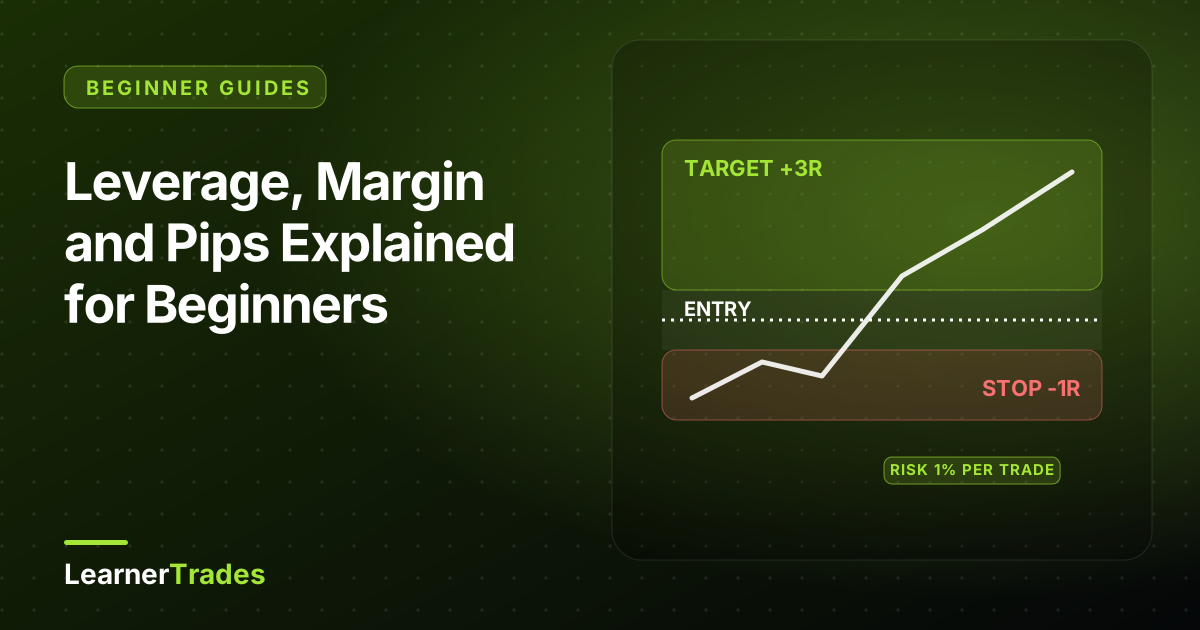
- Leverage: borrowed buying power. It magnifies profits and losses equally. See our leverage, margin and pips guide.
- Stop-loss: an order that closes the trade at a set loss.
- Take-profit: an order that closes the trade at a set profit.
Reading the chart
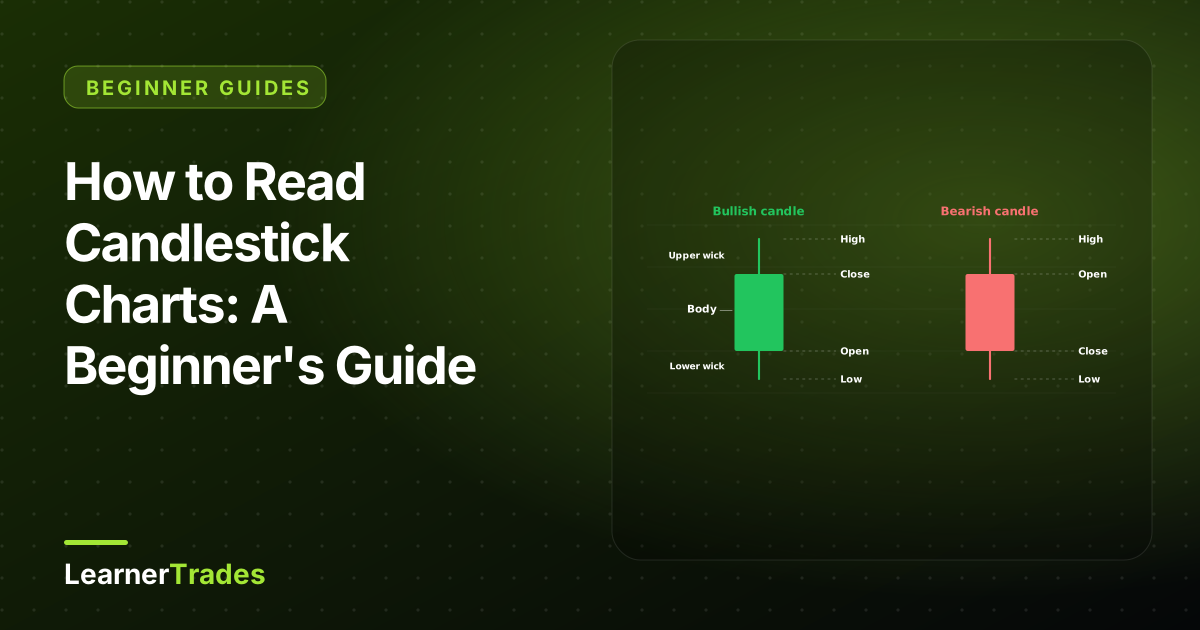
Most traders use candlestick charts. Each candle shows the open, high, low and close for a period. Learn them in how to read candlestick charts.
When to trade
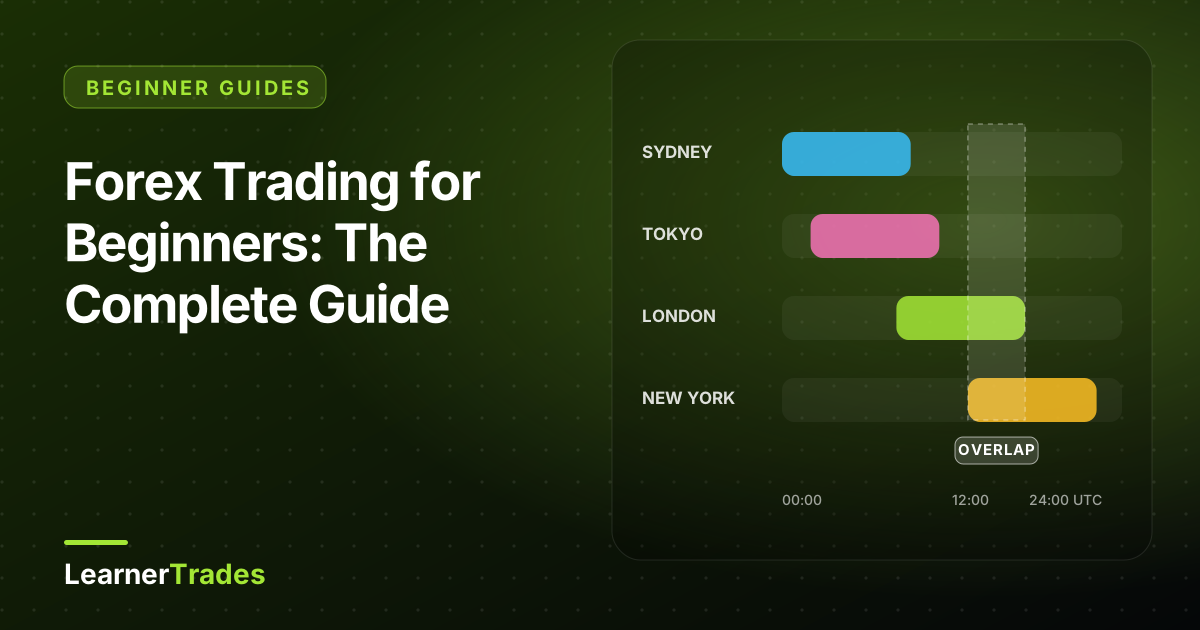
The market rotates through sessions (Sydney, Tokyo, London, New York). Volatility and volume are highest when London and New York overlap. See forex sessions and the best times to trade.
A simple, safe path to your first trades
- Learn the basics (this guide, then candlesticks and market structure).
- Open a demo account and practise for weeks, not days.
- Write a trade plan: setup, entry, stop, target, risk per trade. See the complete trade plan.
- Risk a small fixed percentage per trade (many traders use 1% or less), see risk management.
- Keep a journal and review it weekly.
- Go live small only when your demo results are consistent and you follow your rules.
The truth about losses
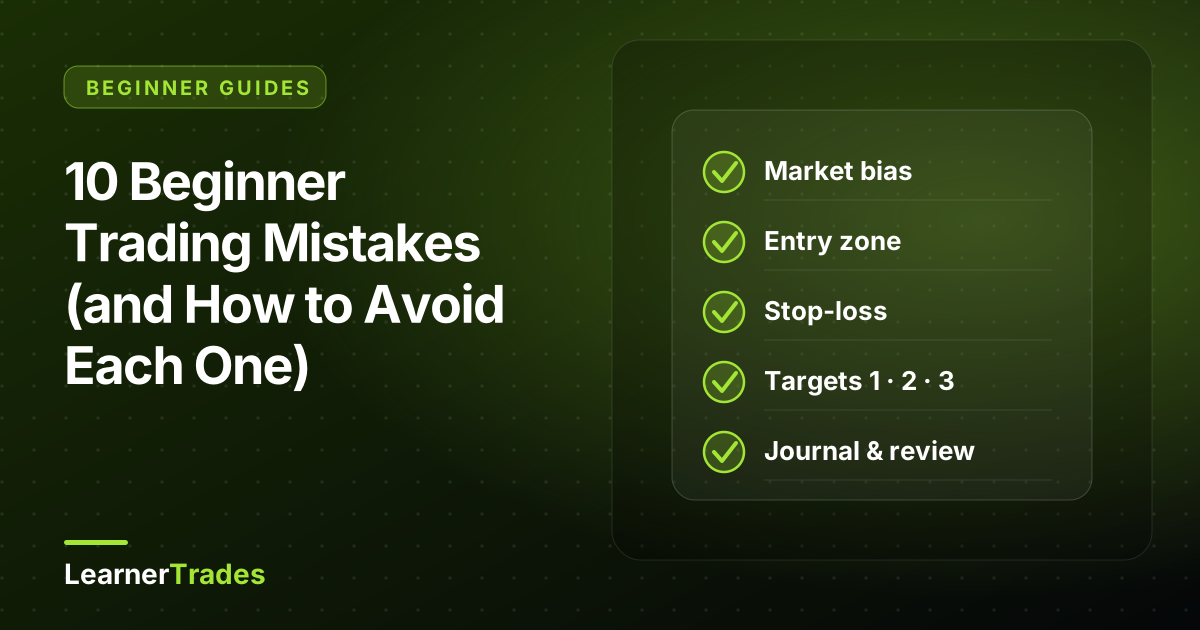
Every trader loses trades. What separates those who last is that their losses are small and planned, and their process is repeatable. Most beginners fail because of oversized positions, no stop-loss and emotional decisions, not because they chose the wrong indicator.
Related guides
- How to read candlestick charts
- Leverage, margin and pips
- 10 beginner trading mistakes
- Forex sessions and best times to trade
- Chart patterns cheat sheet
Sources and further reading
- Bank for International Settlements: Triennial Central Bank Survey of foreign exchange turnover
- Investor.gov (U.S. SEC): investor education
- National Futures Association: investor resources
These are independent official or research sources. Learner Trades is not affiliated with them.
Frequently asked questions
How much money do I need to start trading forex?
Many brokers allow small accounts, but a small account makes sensible risk management harder. Start with money you can afford to lose entirely and practise on a demo account first.
Is forex trading gambling?
It can be if you trade without a plan, edge or risk control. Treated as a skill, with a tested strategy, strict risk management and a journal, it is a probabilistic business, though losses are common and profit is never guaranteed.
What is the best currency pair for beginners?
Major pairs such as EUR/USD offer tight spreads and deep liquidity, which makes them a common starting point.