These four words (pip, lot, margin, leverage) appear in every broker's platform. Misunderstanding them is the fastest way to lose an account, so it is worth getting them exactly right.
Pips
A pip is the standard unit of price movement. For most pairs it is the fourth decimal place (0.0001). For yen pairs it is the second (0.01).
- EUR/USD moves from 1.1000 to 1.1050 = 50 pips.
- USD/JPY moves from 150.00 to 150.50 = 50 pips.
Lots and pip value
The lot is your trade size.
| Lot size | Units of base currency | Approx. pip value on EUR/USD |
|---|---|---|
| Standard | 100,000 | $10 |
| Mini | 10,000 | $1 |
| Micro | 1,000 | $0.10 |
So a 30-pip move on one mini lot of EUR/USD is about 30 x $1 = $30.
Leverage and margin
Leverage lets you control a bigger position than your cash alone would allow. With 1:30 leverage, $1,000 can control about $30,000 of currency.
Margin is the amount of your own money your broker holds as a deposit to keep the position open. It is not a fee; it is a deposit that is released when the trade closes.
The catch: profits and losses are calculated on the full position size, not on your margin. A small move against you can be a large loss relative to your account.
Worked example
- Account: $1,000.
- Position: 1 standard lot of EUR/USD ($10 per pip).
- Price moves 50 pips against you: loss = 50 x $10 = $500. Half the account is gone on a small, ordinary move.
Compare that with 1 micro lot ($0.10 per pip): the same move loses $5.
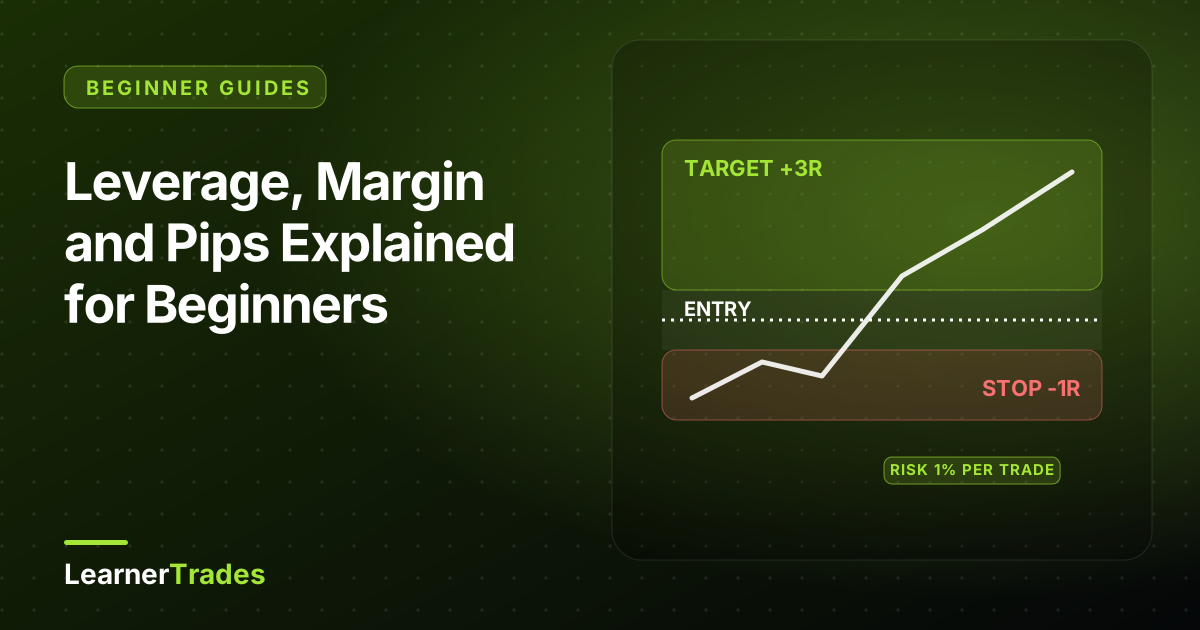
How to size a trade safely
Do not choose the lot size first. Choose the risk first.
- Decide the risk per trade (for example 1% of the account = $10 on a $1,000 account).
- Decide the stop-loss distance from your chart (for example 25 pips).
- Calculate the position: risk / (stop pips x pip value per lot) = lot size.
For the example above: $10 / (25 x $10 per pip per standard lot) = 0.04 lots, which is 4 micro lots. If the stop is hit, you lose about $10, exactly your plan.
See risk management and position sizing for the full framework.
Related guides
- Forex trading for beginners
- Risk management and position sizing
- 10 beginner trading mistakes
- How to write a trade plan
Sources and further reading
These are independent official or research sources. Learner Trades is not affiliated with them.
Frequently asked questions
Is higher leverage better?
No. Higher leverage lets you open larger positions with less capital, but it also magnifies losses. What matters for safety is your actual position size relative to your account and your stop, not the maximum leverage on offer.
What is a margin call?
When losses reduce your account equity close to the margin needed to hold your positions, the broker may warn you or automatically close trades to protect against a negative balance.
How do I calculate pip value?
For a pair quoted in USD such as EUR/USD, one pip on a standard lot (100,000 units) is about 10 USD, on a mini lot about 1 USD and on a micro lot about 0.10 USD.