Ask a hundred losing traders what went wrong and almost none will say "my position sizing was wrong". They will blame the strategy, the broker, the news, the signal. Yet position sizing is the single variable that decides whether an edge is allowed to express itself or gets killed by variance before it can. This article is the one we would make every member read before touching a single signal.
Why risk per trade is everything
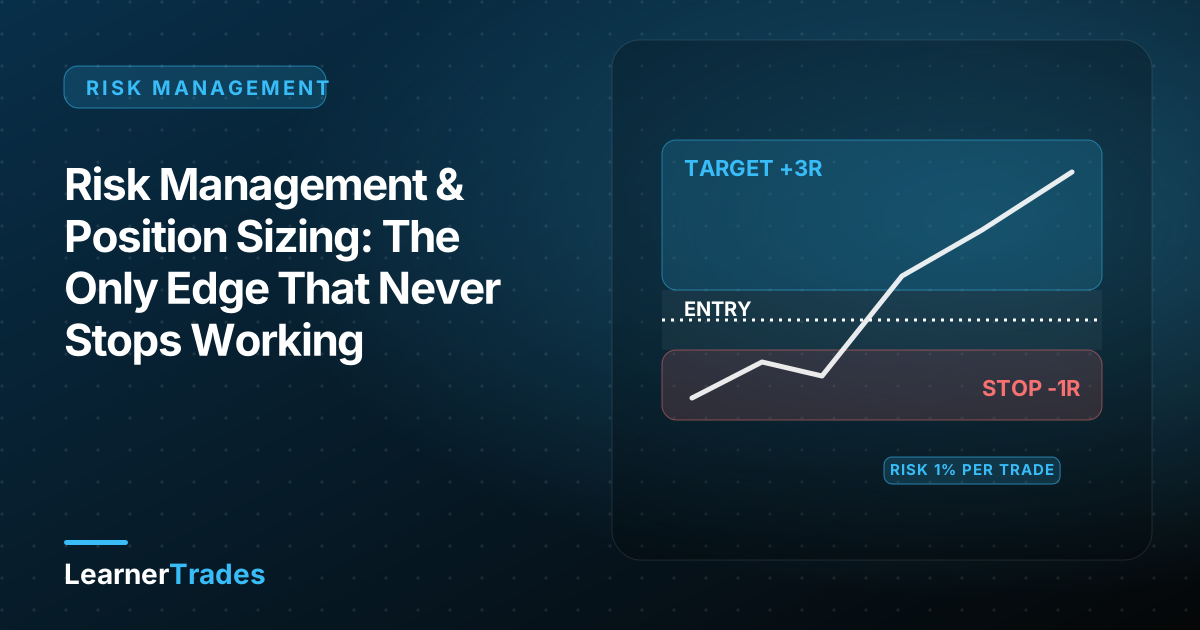
Imagine two traders using the same signals with a 50% win rate and a 1:2 reward-to-risk ratio — a profitable system. Trader A risks 1% of equity per trade. Trader B risks 10%.
After a perfectly normal streak of six losses (probability of that happening at some point over 100 trades is high), Trader A is down about 6%. Trader B is down 47%. To recover, Trader A needs a 6.4% gain. Trader B needs 89%. Same system, same signals; one account is fine, the other is functionally dead.
Losses and gains are asymmetric. A 50% loss needs a 100% gain to recover. Risk management is not about being cautious — it is about making sure you are still playing when the winning streak arrives.
The position sizing formula
Decide the stop first (from structure, see our market structure guide), then compute the size. Never the other way round.
Risk amount   = Account equity × Risk %
Position size = Risk amount ÷ (Stop distance × Value per unit of movement)
Forex example: $5,000 account, 1% risk = $50. GBP/USD long with a 30-pip stop. One standard lot moves ~$10 per pip. Size = 50 ÷ (30 × 10) = 0.17 lots (round down to 0.16).
Gold example: $5,000 account, 1% risk = $50. XAU/USD short with a $12 stop. On most brokers 1 lot = 100 oz, so $1 of movement = $100 per lot. Size = 50 ÷ (12 × 100) = 0.04 lots.
Crypto example: $5,000 account, 1% risk = $50. BTC/USD long at 60,000 with stop at 58,500 (2.5% away). Position value = 50 ÷ 0.025 = $2,000 of BTC (0.033 BTC) regardless of leverage.
Notice that leverage never appears in the formula. Leverage only determines how much margin is locked, not how much you can lose. Risk is defined by stop distance and size.
Drawdown math every trader should memorise
| Loss | Gain needed to recover |
|---|---|
| 5% | 5.3% |
| 10% | 11.1% |
| 20% | 25% |
| 30% | 42.9% |
| 50% | 100% |
| 75% | 300% |
The table is why we cap daily and weekly losses. Our internal rules: stop trading for the day after losing 3% and for the week after losing 6%. Not because the next trade is more likely to lose, but because the trader is.
Expectancy: the number that matters
Win rate alone is meaningless. What matters is expectancy — the average amount you make per trade over many trades:
Expectancy = (Win rate × Average win) − (Loss rate × Average loss)
A system that wins 40% of the time with wins twice the size of losses has an expectancy of (0.4 × 2R) − (0.6 × 1R) = +0.2R per trade. Over 200 trades at 1% risk that is roughly +40% before compounding — with a 60% loss rate. Conversely a 75% win rate with wins half the size of losses has expectancy (0.75 × 0.5R) − (0.25 × 1R) = +0.125R, and feels far better psychologically while making less money. Judge a system by its expectancy and its drawdown, not by how often it wins.
Correlation is hidden over-sizing
Long EUR/USD, long GBP/USD and short USD/CHF at 1% each is not three 1% trades — it is one 3% bet on a weaker dollar. The same applies to BTC and ETH, or XAU/USD and AUD/USD. Group correlated positions and treat the group's total risk as one position.
Scaling out and moving stops
We publish up to three take-profit levels. A simple, robust approach:
- Close one-third at TP1 and move the stop to breakeven.
- Close one-third at TP2 and trail the stop behind the most recent swing.
- Let the remainder run to TP3 or the trailing stop.
Partial profits reduce variance and make it psychologically easier to hold winners. The cost is a slightly lower average win. Many traders find the trade-off worthwhile; test it in your journal.
The rules we do not break
- Define the stop before the size, and the size before the entry.
- Never risk more than 1–2% of equity on one idea, or 5% across correlated ideas.
- Never add to a losing position.
- Never move a stop further away.
- Stop for the day at −3%, for the week at −6%.
- Never trade money you cannot afford to lose — the content on this site is educational and every trade is your own decision.
Related guides
Frequently asked questions
How much should I risk per trade?
Most professional guidance converges on 0.5%–2% of account equity per trade, with 1% being a sensible default. At 1% you can survive a run of 20 consecutive losses with roughly 18% drawdown, which is recoverable. At 10% the same streak wipes you out.
How do I calculate lot size in forex?
Lot size = (Account equity × Risk %) ÷ (Stop-loss in pips × Pip value per lot). For a $5,000 account risking 1% ($50) with a 25-pip stop on EUR/USD ($10 per pip per standard lot), lot size = 50 ÷ (25 × 10) = 0.2 standard lots.
What is a good reward-to-risk ratio?
It depends on your win rate. At a 1:2 reward-to-risk you break even with a 33% win rate; at 1:1 you need over 50%. Most durable systems combine a 40–55% win rate with an average reward-to-risk between 1.5 and 3.