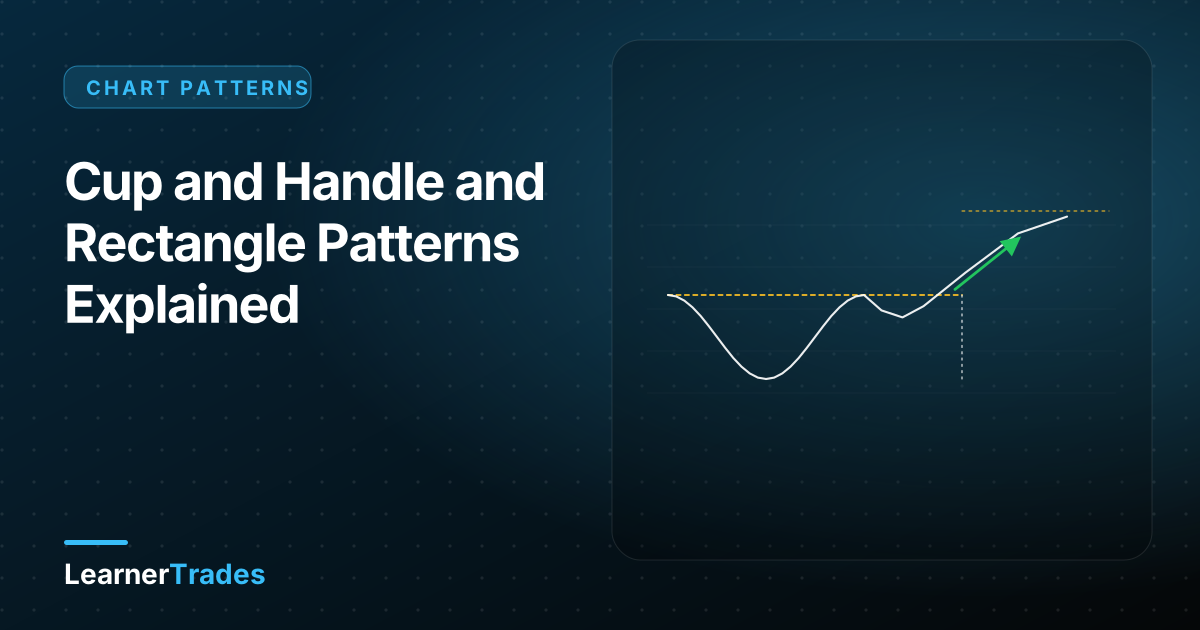
Two patterns that sit at opposite ends of the complexity scale: one is a slow, rounded base that ends in a breakout, the other is a plain range.
Cup and handle (bullish continuation)
Structure:
- The cup: price rounds down from a high and rounds back up to roughly the same level, forming a U shape.
- The handle: a small, shallow pullback just under the rim as the last sellers exit.
- The breakout: a close above the rim (resistance) resumes the uptrend.
Trade plan:
- Entry: a close above the rim, or a retest of the rim as support.
- Stop: below the handle low.
- Target: project the depth of the cup above the breakout.
Quality checks: the cup should be rounded (a sharp V is not a cup), the handle should be shallow and short, and volume typically dries up in the handle and expands on the breakout.
Rectangle (range)
Price moves sideways between a flat support and a flat resistance. Buyers and sellers are in balance.
Two ways to trade it:
- Range trading: buy near support and sell near resistance, with stops just outside the range. It works while the range holds, so keep the position small and use a firm stop.
- Breakout trading: wait for a closing break beyond either side and project the range height as the target.
Common mistakes
- Calling any dip a "cup" without a rounded shape and clear rim.
- Entering inside the handle before the rim breaks.
- Range trading right after a breakout has started.
- Placing stops exactly at the range boundary rather than a little outside.
Related guides
- Bull and bear flag patterns
- Chart patterns cheat sheet
- Support, resistance and liquidity
- How to write a trade plan
Frequently asked questions
How deep should the cup be?
The cup should be a rounded base, not a sharp V. The handle should be a shallow pullback, typically in the upper half of the cup's height.
Can you trade a rectangle inside the range?
Yes. Many traders buy near support and sell near resistance with stops just outside the range, then switch to a breakout plan when price closes decisively outside it.
Does a cup and handle work in forex?
The structure appears in all markets, including forex, gold and crypto. It is more common on higher timeframes.