Trends do not move in straight lines. They surge, pause and surge again. Flags describe the pause.
Bull flag (bullish continuation)
Structure:
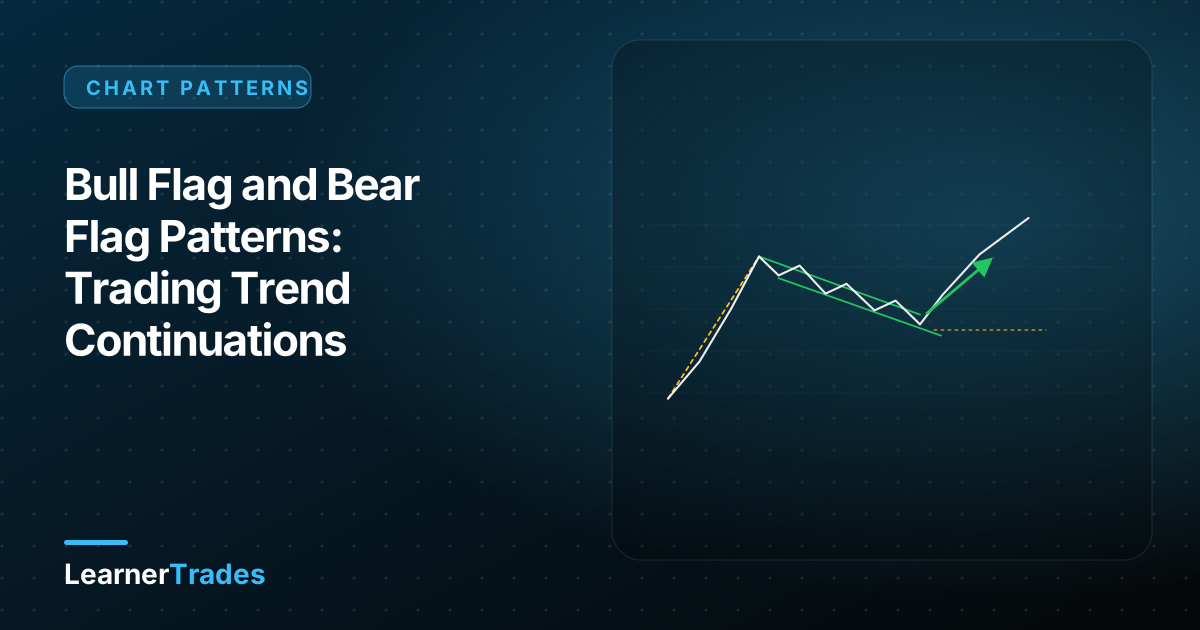
- The pole: a sharp, strong move up, usually on strong momentum.
- The flag: a shallow, orderly pullback in a small channel that slopes down against the trend.
- The breakout: a close above the flag's upper trendline resumes the uptrend.
Trade plan:
- Entry: a close above the upper flag line, or a retest of it.
- Stop: below the flag's lowest point.
- Target: project the length of the pole from the breakout point.
Bear flag (bearish continuation)
The mirror image: a sharp drop (the pole), a shallow bounce in a channel sloping up (the flag), then a close below the flag's lower line resumes the downtrend. Stop above the flag high; target the pole length projected down.
What makes a good flag
- A strong, clean pole. The impulse should be obvious on the chart.
- A shallow, orderly pullback. Deep, messy retracements are not flags.
- Falling volume in the flag, rising volume on the breakout.
- A trend in your favour on the higher timeframe.
Common mistakes
- Buying in the middle of the flag with no breakout.
- Marking a deep correction as a flag.
- Taking a trade with the target blocked by a major level just above the breakout.
- Using a stop so tight that normal flag noise stops you out.
Related guides
- Cup and handle and rectangle
- Chart patterns cheat sheet
- Market structure explained
- Risk management and position sizing
Frequently asked questions
How deep should a flag pull back?
Typically shallow, often retracing less than about 38 to 50 percent of the pole. A deep pullback suggests the move is weakening and the pattern is less reliable.
How long should a flag last?
Flags are short consolidations relative to the pole. If the consolidation drags on for much longer than the move that created it, it is turning into a range rather than a flag.
What is the difference between a flag and a pennant?
A flag consolidates in a parallel channel; a pennant consolidates in a small converging triangle. Both follow a sharp pole and are traded the same way.