A symmetrical triangle is a pause. Volatility compresses, the market coils, and then it expands, but nobody knows in advance which way.
What a symmetrical triangle is
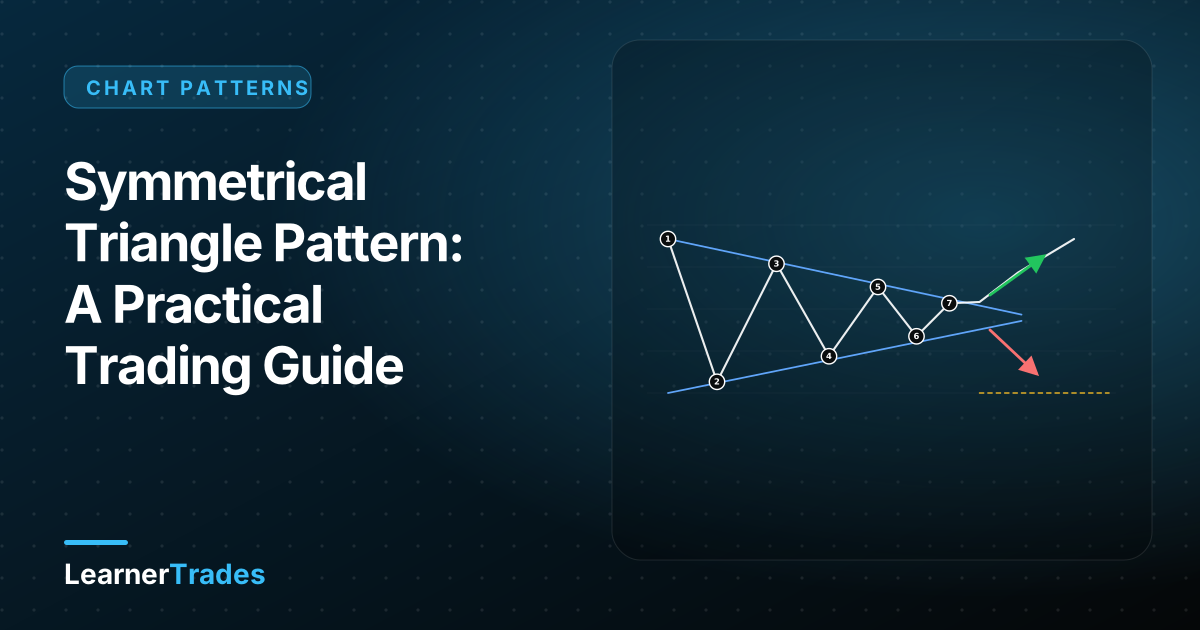
The upper trendline slopes down (lower highs) and the lower trendline slopes up (higher lows), converging toward an apex. Buyers and sellers are both becoming less willing to push price to extremes. It is a market in balance, and balance eventually breaks.
How to identify it:
- At least two lower highs and two higher lows.
- Trendlines meeting at a point to the right of the last candle.
- Decreasing volatility and, often, decreasing volume.
The direction problem
The most honest answer is that you do not know. The pattern often continues the trend that came before it, but that is a lean, not a rule. The professional approach is to let price decide: trade the closing break, not your opinion.
How to trade it
Entry. A candle close outside either trendline. Some traders place a buy-stop above and a sell-stop below and cancel the other once one triggers.
Avoiding false breaks.
- Prefer a close outside the line, not a wick.
- Be cautious with breaks very near the apex, where momentum is usually weak.
- Consider waiting for a retest of the broken line.
Stop-loss. On the opposite side of the last swing inside the triangle, or back inside the pattern by a margin that is bigger than normal noise.
Target. Measure the height of the triangle at its widest point and project it from the breakout.
Common mistakes
- Predicting the direction and entering early.
- Trading a triangle that is too tight to leave room for a sensible stop.
- Ignoring higher-timeframe levels that sit just beyond the breakout.
Related guides
- Ascending and descending triangles
- Chart patterns cheat sheet
- Bull and bear flag patterns
- Market structure explained
Frequently asked questions
Is a symmetrical triangle bullish or bearish?
Neither on its own. It is a neutral consolidation pattern. It tends to resolve in the direction of the prior trend, but that is only a tendency, so wait for a closing break.
How far into the triangle should the breakout occur?
Breakouts that occur roughly two-thirds to three-quarters of the way toward the apex are often considered the most reliable. Breaks very close to the apex tend to be weak.
How do I measure the target?
Measure the widest part of the triangle (the first swing) and project that distance from the breakout point in the direction of the break.