Searching "forex signals" returns a mix of genuine educators and operators selling a dream. Whether signals are worth paying for depends almost entirely on the provider's honesty and on how you use them. Use this checklist.
What a good signal looks like
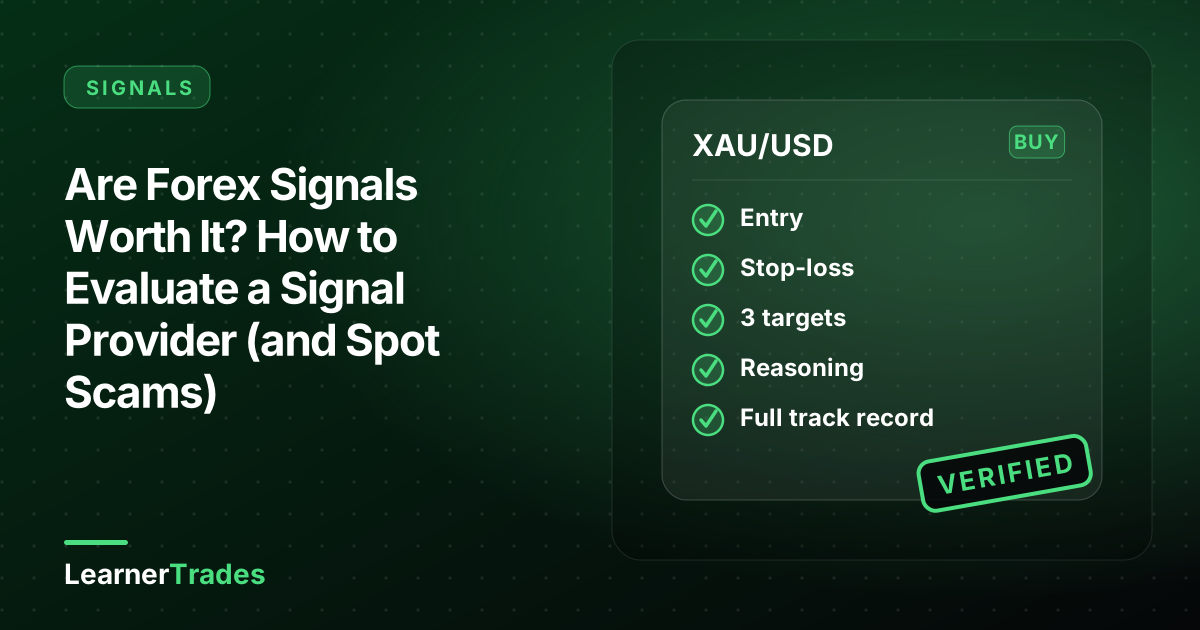
A usable signal always includes:
- Instrument and direction (for example, XAU/USD BUY).
- Entry level or zone, plus the time it was posted.
- A stop-loss. No stop means no defined risk.
- One or more targets.
- The reasoning, so you can learn from it.
Seven checks before you pay
- Is the track record complete? Every signal, including losers, with timestamps. A page showing only wins is marketing.
- How is performance measured? Results in R (multiples of risk) or percentage, with spreads and slippage considered, are more honest than "pips".
- What is the risk-reward? A provider with a modest win rate and strong risk-reward can be more credible than one claiming 95% wins.
- Are claims realistic? Guaranteed profit, fixed monthly returns and "risk-free" are all red flags.
- Is there transparency about drawdowns? Every strategy has losing streaks. Honest providers show them.
- Do they push leverage or a specific broker? Heavy pressure to use a particular broker or high leverage often signals a referral-commission motive.
- Is the product clear about being educational? Responsible providers state the risks plainly and avoid promising outcomes.
Red flags
- Screenshots of profits with no verifiable source.
- Countdown timers and "only 3 spots left" pressure.
- Private-message "VIP" upsells.
- No stop-loss on signals.
- No refund, no contact details, no business identity.
How to use signals safely
- Treat them as ideas, not orders. Understand the setup before you act.
- Size every trade yourself using your own fixed risk percentage.
- Always use the stop.
- Paper-trade or use a small size first to see how the provider performs in practice.
- Keep a journal so you can measure your results, not just theirs.
Our approach
At Learner Trades we publish ideas only when a setup is worth taking, so some days have no signal. Every idea is tracked automatically against live prices and the result, win or loss, is shown. We are an educational service, not financial advice. See our risk management guide for the sizing rules we recommend with any signal.
Related guides
- Risk management and position sizing
- Forex trading for beginners
- 10 beginner trading mistakes
- Trading psychology
- Today's tracked signals
Sources and further reading
- Investor.gov (U.S. SEC): investor education and fraud alerts
- National Futures Association: investor resources
- Financial Conduct Authority: ScamSmart
These are independent official or research sources. Learner Trades is not affiliated with them.
Frequently asked questions
Can forex signals guarantee profit?
No. No provider can guarantee profit. Anyone promising guaranteed returns, a fixed win rate or "risk-free" trades is a red flag.
How do I verify a signal provider's results?
Look for a complete, timestamped record that includes losing trades, results measured in R-multiples or percentage with realistic spreads, and ideally independent verification. Screenshots and cherry-picked wins are not proof.
Should I copy signals blindly?
No. Use signals as ideas to learn from, size every trade to your own risk rules and always use the stop-loss. Understanding why a setup exists is what builds skill.